

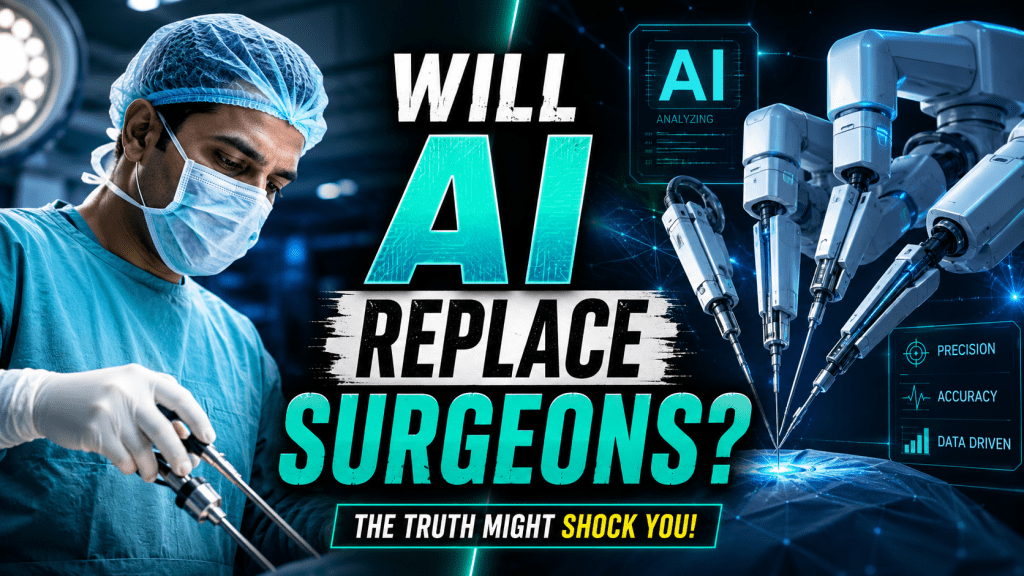
AI vs Human Surgeons
“Will AI replace doctors in the future?”
This question is everywhere right now.
From ChatGPT giving medical answers to robotic surgeries making headlines, many patients are wondering whether human surgeons will eventually become unnecessary.
Social media is full of debates:
- AI vs Doctors
- Robots in operation theatres
- AI diagnosis tools
- Fear of machines replacing healthcare professionals
But here’s the truth nobody talks about:
👉 Healthcare is not just data. It is human decision-making.
AI is transforming medicine in incredible ways.
But surgery is not just about analysing reports or following patterns.
It is about:
- Judgement
- Timing
- Experience
- Understanding the patient beyond the scan
💡 “AI can analyse data. A surgeon understands the patient.”
1. Why AI in Healthcare Is Growing So Fast
Artificial Intelligence is becoming more powerful every year.
Today, AI can:
- Analyse scans quickly
- Detect patterns in reports
- Predict complications
- Assist robotic surgeries
- Organise medical data faster than humans
This has improved:
✔ Accuracy
✔ Speed
✔ Surgical precision
✔ Workflow efficiency
Naturally, people are asking:
“If AI can do all this… why do we still need surgeons?”
2. What AI Can Actually Do Well
AI is excellent at:
🔹 Pattern Recognition
It can analyse thousands of cases and identify similarities rapidly.
🔹 Data Processing
AI handles huge medical datasets within seconds.
🔹 Surgical Assistance
Robotic-assisted surgery improves precision in certain procedures.
🔹 Predictive Analysis
AI can estimate surgical risks and recovery patterns.
In many ways, AI is becoming a powerful assistant for doctors.
But assistant ≠ replacement.
3. What AI Cannot Replace
This is where reality changes.
🔹 1. Clinical Judgment
A patient is not just:
- A scan
- A report
- A lab value
Two patients with the same diagnosis may need completely different treatments.
An experienced surgeon considers:
- Age
- Lifestyle
- Fear
- Medical history
- Emotional condition
- Risk tolerance
AI cannot fully understand human complexity.
🔹 2. Decision Timing
One of the most important parts of surgery is deciding:
- When to operate
- When NOT to operate
- When to wait
- When surgery may be dangerous
💡 Strong truth:
“AI can suggest. A surgeon decides.”
🔹 3. Handling Emergencies
During surgery, unexpected complications can happen instantly:
- Bleeding
- Tissue damage
- Hidden infection
- Anatomical variations
A surgeon adapts in real time.
AI cannot independently think beyond its programming.
🔹 4. Human Trust & Reassurance
Patients don’t just need treatment.
They need:
✔ Confidence
✔ Emotional support
✔ Reassurance
✔ Explanation
✔ Human understanding
A machine cannot comfort a scared patient before surgery.
4. Why Doctors and Patients Still Trust Human Expertise
Across Reddit and healthcare discussions, both doctors and patients repeatedly agree on one thing:
👉 AI is a tool — not a replacement.
People appreciate:
- Technology
- Faster diagnosis
- Better reports
But when it comes to surgery, they still trust:
✔ Human judgement
✔ Experience
✔ Responsibility
Because when complications arise, patients want a surgeon—not an algorithm.
5. The Real Future: AI + Surgeons Together
The future of medicine is not:
❌ AI vs Doctors
It is:
✅ AI + Doctors
AI will:
- Improve efficiency
- Reduce errors
- Enhance diagnosis
- Support surgical planning
But surgeons will still:
- Make final decisions
- Understand patients
- Handle complexities
- Take responsibility for outcomes
The best healthcare happens when:
💡 Technology and human expertise work together.
## 6. Why Experience Still Matters in Surgery
A senior surgeon develops something AI still cannot replicate:
Experience-based instinct.
After years of real surgeries, doctors recognise:
- Patterns
- Complications
- Warning signs
- Risks before they happen
This comes from:
- Real patients
- Real outcomes
- Real responsibility
That human instinct still matters deeply in surgery.
✅ Doctor’s Insight — From Dr. Sanjeev Gupta
“Patients often ask me whether AI will replace surgeons someday.
What I explain is simple:
AI is an excellent tool, but surgery is not just science—it is judgement.
Technology can assist us with data and precision, but understanding a patient’s condition, fears, and treatment timing still requires human experience.
The future of healthcare will not be AI replacing doctors.
It will be AI helping doctors provide better care.”
✅ Voice Search FAQs (AEO Optimized)
1. Can AI replace surgeons completely?
No. AI can assist surgeons but cannot replace human judgment, decision-making, and patient understanding.
2. Is AI used in surgery today?
Yes. AI is used in robotic-assisted surgery, diagnosis support, and surgical planning.
3. Are robotic surgeries done by robots alone?
No. Robotic surgeries are controlled and monitored by experienced surgeons.
4. Why can’t AI replace doctors?
Because healthcare involves emotional understanding, clinical judgment, and complex decision-making beyond data.
5. Is AI diagnosis always accurate?
AI can support diagnosis, but final medical decisions should always involve a qualified doctor.
