

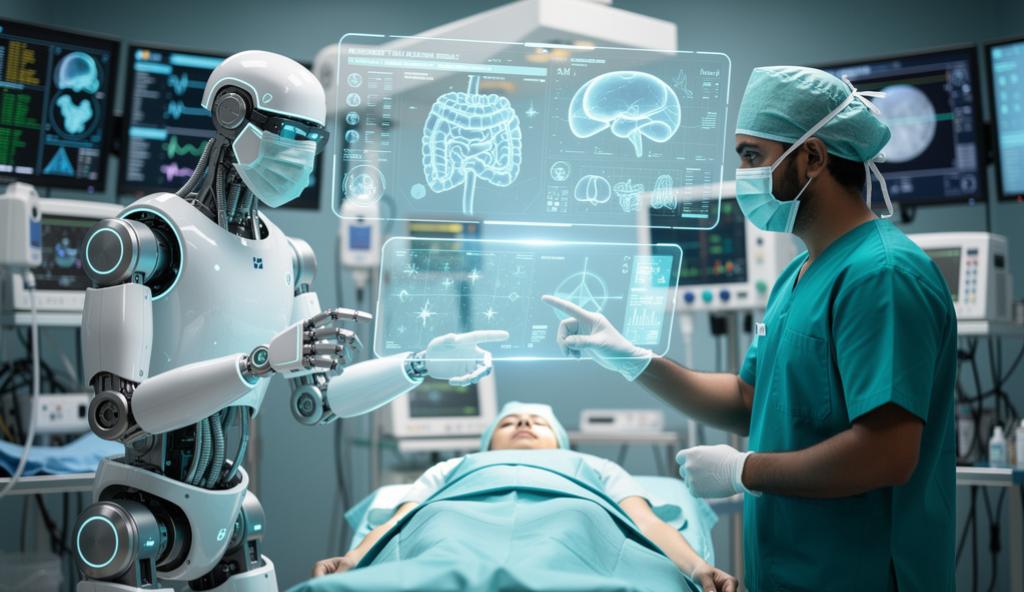
Can AI Replace Surgeons? A Senior Surgeon’s Perspective
“Doctor, ab AI aa gaya hai… kya future mein surgeons ki zarurat nahi rahegi?”
This is a question many patients — and even young professionals — are asking today.
With AI diagnosing diseases, analyzing scans, and even assisting in robotic surgeries, it’s natural to wonder:
Will machines replace human surgeons?
The answer is both simple and important —
AI can assist, but it cannot replace.
Because surgery is not just about precision…
It is about judgment, timing, and human understanding.
1. What AI Can Do in Modern Surgery
Artificial Intelligence is already playing a powerful role in healthcare.
🔹 1. Better Diagnosis
AI can analyze:
- X-rays
- CT scans
- MRI reports
…with impressive speed and accuracy, helping doctors detect conditions early.
🔹 2. Surgical Assistance
In robotic and laparoscopic procedures, AI can:
- Enhance precision
- Reduce human error
- Assist in complex movements
This improves outcomes, especially in delicate surgeries.
🔹 3. Predicting Risks
AI tools can:
- Predict complications
- Suggest treatment pathways
- Help in planning surgery
This supports surgeons in making informed decisions.
2. What AI Cannot Replace in Surgery
Despite its capabilities, AI has clear limitations.
🔹 1. Clinical Judgment
Every patient is different.
Two patients with the same condition may need completely different treatments.
AI can suggest options — but choosing the right option requires experience.
🔹 2. Decision Timing
One of the most critical aspects of surgery is timing.
- When to operate
- When to wait
- When to avoid surgery completely
👉 Strong truth:
“AI can suggest, but it cannot decide when not to operate.”
🔹 3. Handling Unexpected Situations
During surgery, unexpected complications can arise.
- Sudden bleeding
- Tissue variation
- Hidden conditions
A surgeon must think, adapt, and act instantly — something AI cannot independently do.
🔹 4. Human Connection & Trust
Patients don’t just need treatment — they need reassurance.
- Understanding fear
- Explaining risks
- Building confidence
These are deeply human elements that machines cannot replicate.
3. Surgery Is More Than a Procedure — It’s a Decision
Many people believe surgery is about performing an operation.
In reality, the most important decision is often:
“Should we operate at all?”
An experienced surgeon considers:
- Patient condition
- Risk vs benefit
- Alternative treatments
- Long-term outcomes
AI may provide data — but wisdom comes from experience.
4. The Future: AI + Surgeon, Not AI vs Surgeon
The real future of healthcare is collaboration.
✔ AI will enhance diagnosis
✔ AI will improve precision
✔ AI will reduce complications
But the surgeon will:
✔ Make final decisions
✔ Customize treatment
✔ Ensure patient safety
The best outcomes will come from technology + human expertise working together.
5. Why Experience Still Matters in Surgery
A senior surgeon brings:
- Years of real-life case handling
- Pattern recognition beyond data
- Confidence in complex decisions
These are things AI is still learning — and may never fully replicate.
Because experience is not just information…
It is judgment built over time.
✅ Doctor’s Insight — From Dr. Sanjeev Gupta
“Patients often ask me if AI will replace surgeons in the future.
What I tell them is — AI is a powerful tool, but it is still just a tool.
It can assist in diagnosis and improve precision, but it cannot replace clinical judgment.
In surgery, the most important decision is not just how to operate — but whether to operate at all.
And that decision requires experience, understanding, and responsibility toward the patient.”
✅ Search FAQs
1. Can AI perform surgery on its own?
No. AI can assist in surgery, but it cannot independently perform or make surgical decisions.
2. Will surgeons be replaced by AI in the future?
No. AI will support surgeons, but human judgment and decision-making cannot be replaced.
3. Is AI used in surgery today?
Yes. AI is used in diagnosis, surgical planning, and robotic-assisted procedures.
4. Why can’t AI replace surgeons?
Because surgery requires judgment, experience, emotional understanding, and real-time decision-making.
5. Is AI-based surgery safer?
AI-assisted surgery can improve precision, but safety depends on the surgeon’s expertise.
